Descriptive transcript
[00:00]
John Roberts stands beside an automated textile sorting machine inside an RGI facility. A colleague works at the machine behind him. An on-screen caption identifies John as Director of Circularity & Innovation at Roberts Group International.
John Roberts: Hi, I’m John Roberts. I’m Director of Innovation and Circularity at Roberts Group International. And today we’re very excited to talk you through some of the features of the latest AI sorting technology which we have recently invested in.
[00:14]
Close-up and overhead shots show a garment travelling along the machine’s conveyor and passing beneath its scanning unit.
[00:20]
John Roberts: There are a number of reasons why we chose this machine over similar machines. There’s plenty of features that we’re excited to tell you about today. It’s going to be modelled by Head of Tech, Shan, and some of the features we’re going to reserve till after we’ve had a successful trial.
Shan operates the machine from a laptop while John speaks. An overhead view shows the sorter and conveyor within the facility.
John Roberts: The automatic sorting space is an industry that we’ve been watching over the last decade or so. When we acquired this facility, we knew that a certain proportion of it was going to be reserved for a development which, as yet, hadn’t come to the market. And now we feel like, if trials and pilots are successful, this could be that technology.
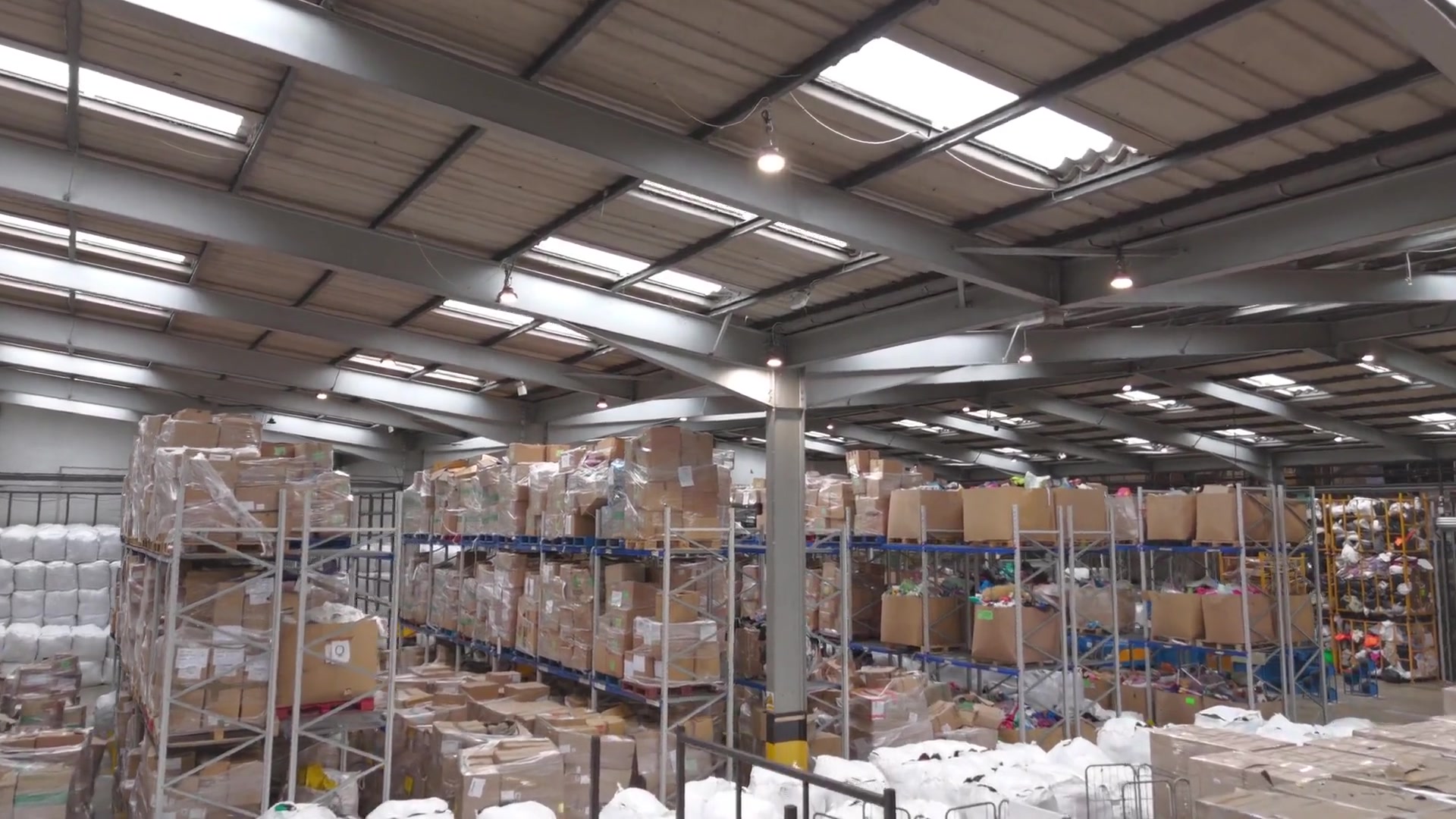
Views of the facility and textile storage cages are shown.
[00:57]
An on-screen title reads: “Fibre to Fibre.” Garments are placed on the conveyor, illuminated and scanned as they move through the machine.
John Roberts: One of the hardest topics in our industry is, of course, fibre-to-fibre recycling. So any machine that’s in this space will be judged on how it recycles non-rewearable textiles. This does have an NIR sorting aspect to it. However, what’s most exciting about this machine is it combines it with AI technology. So it can also look for disruptors—maybe it’s multiple materials, not just a monofibre—and then it can decide the most appropriate recycling route, which in the future could be fibre-to-fibre recycling, although we know that that’s still in development, especially in the UK.
[01:34]
John and Shan stand at the sorting table as garments continue along the conveyor. Close-up and overhead shots show different garments being scanned and directed through the system.
John Roberts: One of the features which I know has got Shan really excited is the level of data that we’re going to be able to produce with this machine, because Shan is often tasked with producing the reports for our brand partners. And now we’re going to be able to tell them exactly where their material went after it left us. So we’ll be able to give a full breakdown and a level of transparency and detail that just couldn’t be done before.
John Roberts: During a recent conversation with one of our partners, we heard of their plans to introduce RFID tags, which are being spoken about as a potential way of having digital product passports. So this machine’s actually been future-proofed because, if that system is adopted, we’ll be able to read the tags and eventually upload information at the same time.
[02:16]
An on-screen title reads: “Economical Repairs.” The conveyor separates garments into different destinations.
John Roberts: One of the features which I am personally most excited about is a topic that is rarely spoken about in our industry, and it’s economical repairs. So if an item has a high value, but it has maybe a small rip, then that is a category which we can sort for, and we can send it to be repaired in the UK and contribute to the circular economy.
[02:40]
The RGI logo appears, followed by the message: “Brands… Let’s Talk.” John then returns on screen beside the conveyor.
John Roberts: While we are in the pilot stage, we’re actually inviting down any brand or retailer that’s interested to find out the data about their customer returns or excess stock. Put the machine to the test. Come down, see how it works, see the factory, see the setup, and see how we can help you with your sustainability goals.